The first prize-winners were honoured at the inaugural science competition held as part of the ‘State & Administration’ Future Congress.
Julian Koch and Michael Trampler from the South Westphalia University of Applied Sciences have won first prize in the ‘Science Dialog’ administration competition with their entry ‘Mockups 4 Robotic Process Automation’. Second place went to Dian Balta from fortiss, the Free State of Bavaria’s research institute for software-intensive systems and services, for his entry ‘No-Stop-Shop: OZG 2.0 in 2027?’. Dr Constantin Houy from the German Research Centre for Artificial Intelligence (DFKI) received third prize for “The Potential of AI-Supported Case Management in Social Services”.
The Science Dialog Award honours researchers whose work provides particularly valuable impetus for the implementation of the Online Access Act (OZG) in public administration. Under the patronage of Minister of State for Digital Affairs Dorothee Bär, the prize was awarded for the first time as part of the ‘Future Congress on State & Administration’ in cooperation with the National E-Government Competence Centre and the e-government specialist ]init[ AG for digital communication.
The patron of Science Dialog, Minister of State for Digital Affairs Dorothee Bär, congratulates the award winners: “The pressure to innovate within the civil service has increased as a result of the Online Access Act. Ideas from the academic world, such as those presented at the Science Dialogue, breathe new life into the discussion and drive our digitalisation forward. I am very much looking forward to seeing how the proposals are implemented in administrative practice.”
Dirk Stocksmeier, initiator of the Science Dialog, added: “With the Science Dialog, we have provided a platform for creative minds and innovative ideas and given a powerful boost to the exchange between public administration practitioners and academics. The projects and research initiatives presented provide impetus for the implementation projects now getting under way in the context of the Online Access Act. The award winners, in particular, demonstrate concrete approaches to how digitalisation can simplify and accelerate administrative processes.”
The prize-winners were selected through an open, participatory competition process. From 17 entries, the expert jury selected five submissions during a meeting to proceed to the final round at the Future Congress. There, the competition participants presented their entries in a public ideas contest. Following the pitch, the winners were determined and awarded prizes based on a 50 per cent vote from the jury and a 50 per cent vote from the audience. The Science Dialog is endowed with a total prize fund of 9,000 euros.
1st prize: ‘Mockups 4 Robotic Process Automation’
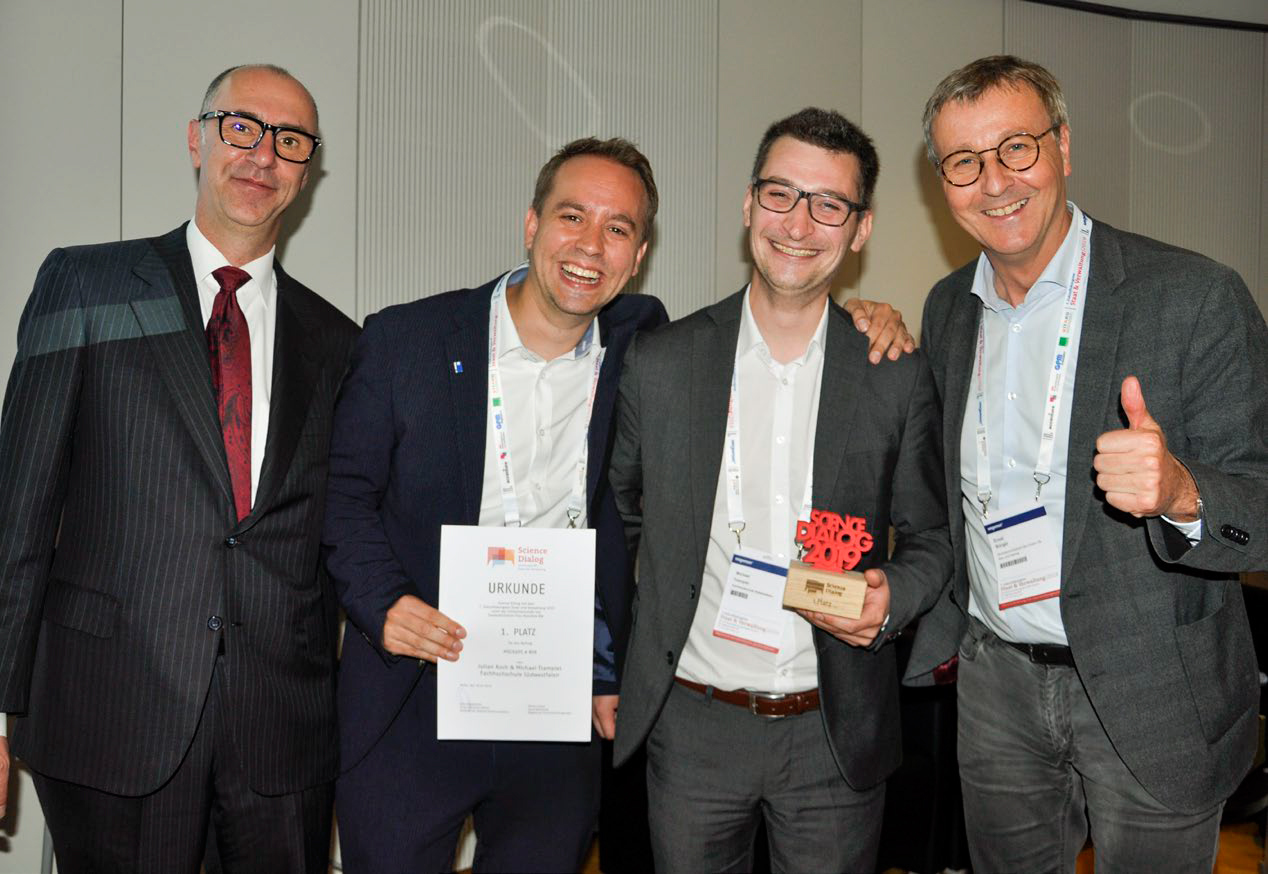
The article ‘Mockups 4 Robotic Process Automation’ by Julian Koch and Michael Trampler
(South Westphalia University of Applied Sciences) aims to digitise and automate processes in public sector organisations with the help of software robots. Robotic Process Automation (RPA) makes it possible to replicate processes and then optimise them – without actually having access to the relevant applications and data in the production and operational environment. The transformation can therefore be achieved without large IT budgets and with comparatively little technical effort.
2nd prize: ‘No-Stop-Shop: OZG 2.0 in 2027?’
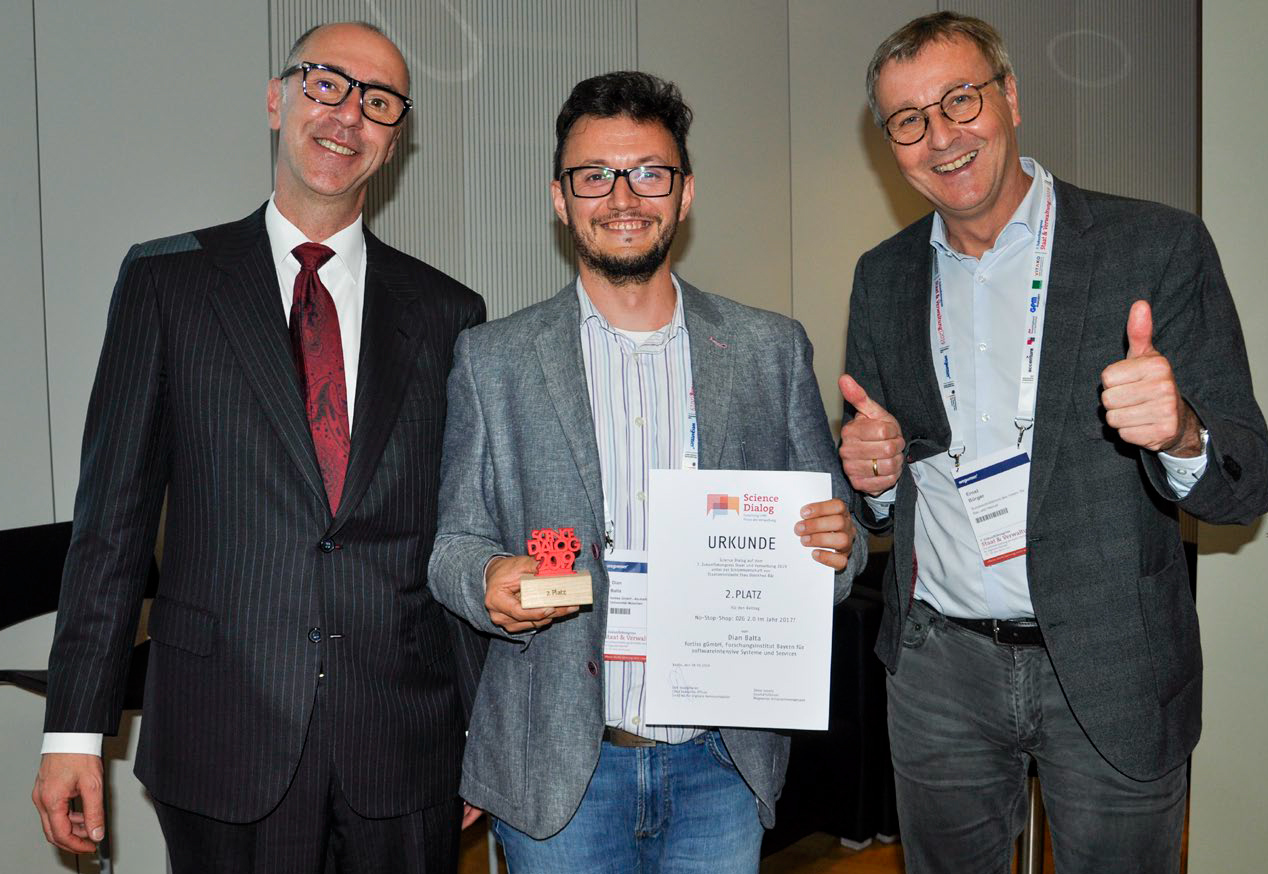
The article “No-Stop-Shop: OZG 2.0 in 2027?” by Dian Balta (fortiss), Hendrik Scholta (University of Münster) and Michael Kolain (German Research Institute for Public Administration, Speyer) focuses on user-friendly services that do not require applications. Analytical tools and data-driven predictions ensure that the administration can anticipate whether
a service is relevant to the citizen. The authority then provides the service without being asked.
3rd prize: ‘The potential of AI-supported case management in social services’
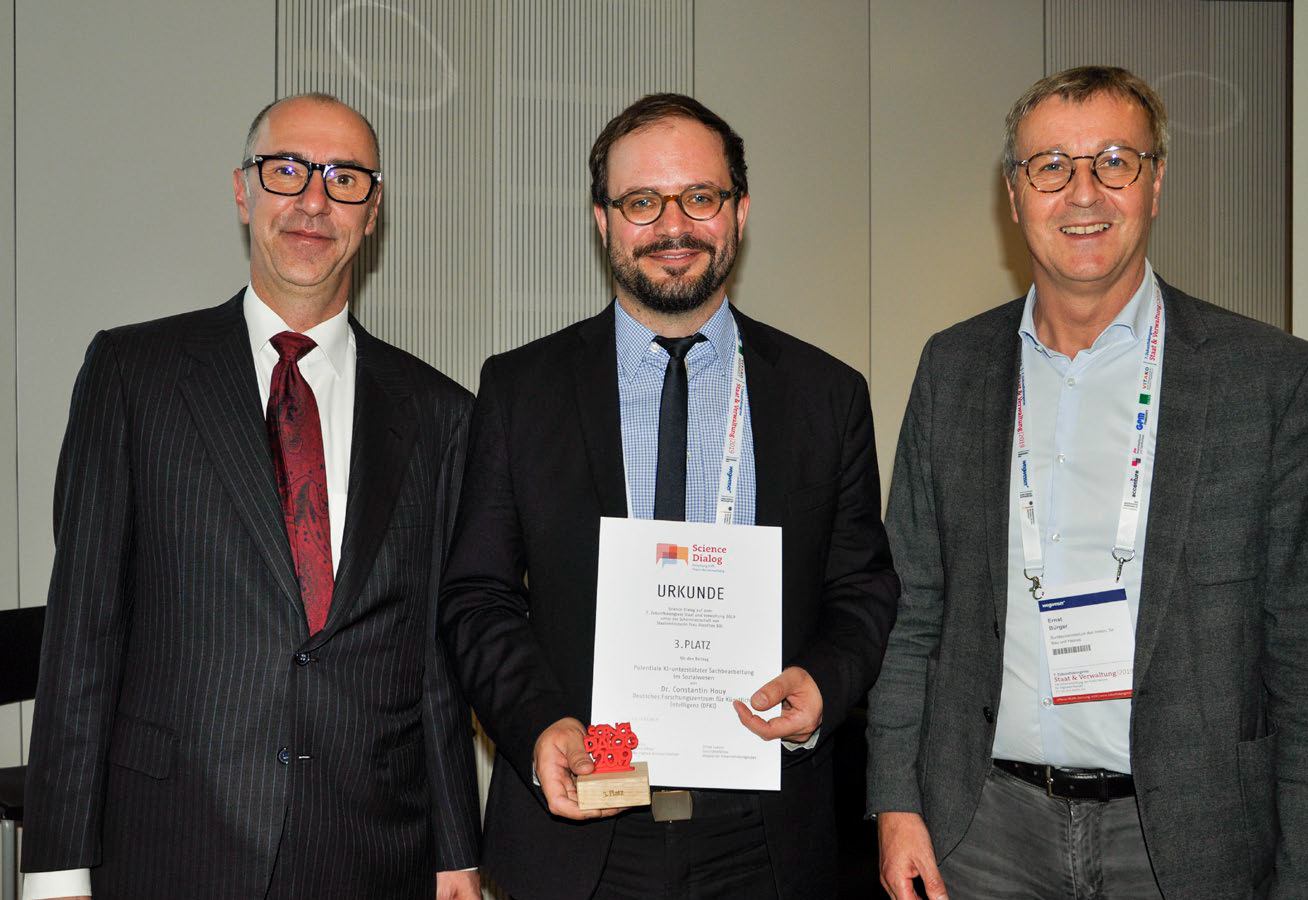
In his article ‘The Potential of AI-Supported Case Management in Social Services’, Dr Constantin Houy from the German Research Centre for Artificial Intelligence (DFKI) explores the possible applications of artificial intelligence in public administration. The potential of AI is examined using two scenarios in the social services sector characterised by high case volumes and large amounts of data: the procedure for determining severe disability and integration assistance.
About the Science Dialogue
Transformation requires impetus. Modernising public administration requires science. That is why the Science Dialogue brings together innovative minds from the world of research with practitioners from the field of public administration. Innovative scientists inspire new ways of thinking
and transformative approaches. Leading thinkers challenge the status quo and explore its potential.
To achieve this aim, the Science Dialog is divided into three distinct formats: the ‘Inspire’ science competition and project slam focuses on creative ideas, solutions, tools and methods for the digitalisation of public administration. In the ‘Debate’ panel
and the panel discussion ‘Gamechanger: the Online Access Act’, established e-government experts discussed the current status of the OZG’s implementation.
The patron of the Science Dialog is Minister of State Dorothee Bär, the Federal Government Commissioner for Digitalisation.
The members of the expert jury:
• Prof. Dr Maria A. Wimmer, Dean of the Faculty of Computer Science, Head of the E-Government Research Group; University of Koblenz-Landau
• Prof. Dr Robert Krimmer, Professor of E-Governance, Ragnar Nurkse Department of Innovation and Governance at the School of Business and Governance, Tallinn University of Technology, Estonia
• Univ.-Prof. Dr Hermann Hill, Chair of Public Administration and Public Law, German University of Administrative Sciences Speyer
• Senior Ministerial Director Ernst Bürger, Head of the Sub-department for Administrative Digitalisation and Administrative Organisation
• State Councillor Henning Lühr, CIO for Bremen in the Senate Department of Finance of the Free and Hanseatic City of Bremen
• Thomas Wiesler, CIO, City of Mannheim
• Susanne Diehm, Head of Public Services & Healthcare, Member of the Executive Board; SAP Deutschland SE & Co. KG
• Dr Katrin Sobania, German Association of Chambers of Industry and Commerce (Deutscher Industrie- und Handelskammertag e.V.)
• Dirk Stocksmeier, CEO, ]init[ AG