A message from the CEO

Why Wegweiser is organising this conference
LEARNING FROM EACH OTHER – MOVING FORWARD TOGETHER
Dear Future Congress community,
Artificial intelligence has long been an integral part of almost all Wegweiser events. Another congress that merely discusses opportunities and risks in general terms would therefore be superfluous.
What is lacking, however, is a dedicated forum where the public sector can bring together what is already happening across different institutions and areas of government responsibility. In many places, AI applications are being developed that tap into knowledge, analyse documents, structure processes, support communication or transform workflows. However, experience with these often remains confined to the places where it was gained.
Yet very similar questions arise across organisational and departmental boundaries: Which technologies are viable? Which models and platforms are suitable for public sector use? How can security, quality and human accountability be guaranteed? What can public IT service providers and data centres achieve on their own – and where are specialised, European or international partners required?
The ZuKo Special: AI in Government & Administration brings these experiences together. Public institutions demonstrate what they are already working with. Experts explain what the technology is capable of today and where its limitations lie. Politicians, public IT professionals and market representatives discuss what capabilities and infrastructure the state needs now.
This is not about a showcase of new products. It is about learning from one another, avoiding duplicating efforts on similar tasks, and reaching sound decisions more quickly.
I look forward to an open and practical exchange of views.
Yours,
Oliver Lorenz
CEO Wegweiser Media & Conferences GmbH
Brief description
The ZuKo Special: AI in Government & Administration is the practice-oriented AI conference for the federal government, the Länder and public institutions. It brings together experiences across departmental, administrative and organisational boundaries – so that the public sector can learn from one another and make faster progress together.
The focus is on specific applications and the technology itself: what can AI do today? Which experiences can be replicated? Which models, platforms, providers and infrastructures enable secure and efficient operation?
The joint main programme combines practical experience, technological analysis and policy decisions. The accompanying short study ‘AI in Practice in Government & Public Administration 2027’ examines current applications and potential, identifies best practices and presents its findings for the first time at the conference.
- 24. February 2027
-
Conference Centre
Hotel de Rome
Behrenstraße 37
10117 Berlin
- Hotline
+49 30 284881-0
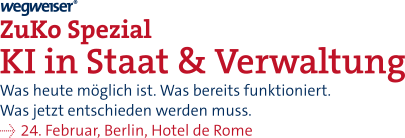
ZuKo Special: AI in Government and Public Administration
What is possible today. What is already working. What needs to be decided now.
You will find the participation options here.
All participation options for you at a glance.
Use to add a session to your personal program.
Then open it here and sync it with your calendar.
A conference day on which the public sector can understand what AI is capable of today, see what others are already doing with it, and, together with policymakers, public IT departments and leading providers, clarify what this means for Germany.
The programme is a ‘work in progress’; subject to change.